Do-It-Yourself-1: Welcome, Grade 3 Mathematicians!
Today, we’re going to become experts at comparing and ordering numbers. This skill helps us understand the size of numbers and how they relate to each other, which is super important in our daily lives! We’ll start by building our own number models using everyday items.
Do-It-Yourself-2: Concrete Model Building – Representing Numbers
To begin, gather some simple materials. You’ll need:
- Craft sticks (or similar items like dried pasta sticks, ice cream sticks)
- Small rubber bands (or string)
- A flat surface to work on
Now, let’s build our numbers! We’re going to represent numbers up to 999 using a place value system:
- Representing Ones: Take single craft sticks. Each single stick represents one unit.
- Representing Tens: Bundle ten craft sticks together with a rubber band. This bundle represents ten units, or one ‘ten’.
- Representing Hundreds: Take ten bundles of ‘tens’ (which is 10 x 10 = 100 sticks) and bundle them together to form one large ‘hundred’ bundle. This bundle represents one hundred units.
Build your own model. For example, to represent the number 345, you would make three ‘hundred’ bundles, four ‘ten’ bundles, and five single ‘one’ sticks. Take your time to create a few different numbers, like 123, 567, and 309, using your physical models.
Do-It-Yourself-3: Comparing Numbers with Your Concrete Models
Now that you have your number models, let’s compare two numbers. This is where we learn which number is greater, smaller, or if they are equal.
- Choose Two Numbers: Select two numbers, for example, 253 and 235.
- Build Both Numbers: Create the physical models for both 253 (two hundred bundles, five ten bundles, three ones) and 235 (two hundred bundles, three ten bundles, five ones).
- Compare the Largest Place Value First: Place both models side-by-side. Start by comparing the ‘hundreds’ bundles. For 253 and 235, both have two hundred bundles. Since they are the same, we move to the next place value.
- Compare the Next Place Value: Next, compare the ‘tens’ bundles. For 253, you have five ‘ten’ bundles. For 235, you have three ‘ten’ bundles.
- Determine Greater/Smaller: Since five ‘ten’ bundles (50) is greater than three ‘ten’ bundles (30), you can clearly see that 253 is greater than 235, even though their ‘hundreds’ are the same.
Practice comparing other pairs of numbers like 418 and 481, or 670 and 670. What happens if the hundreds and tens are the same? You would compare the ‘ones’ next!
Design-It-Yourself-1: Pictorial Representation – Visualizing Numbers
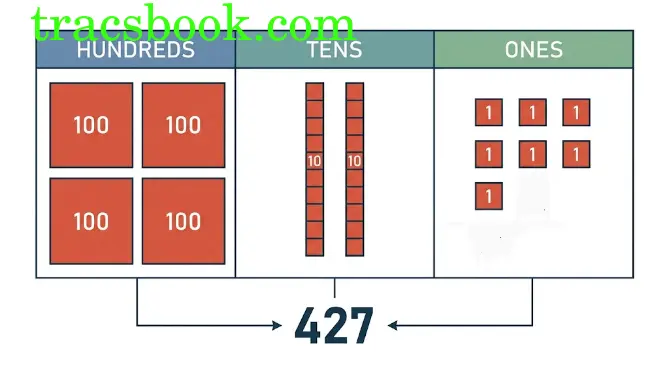
Great job with your physical models! Now, let’s move from building with sticks to drawing numbers. This helps us visualize numbers and their values without needing physical objects. We’ll use simple blocks to represent hundreds, tens, and ones in a place value chart.
- Hundreds: We’ll use a large square block.
- Tens: We’ll use a long, thin rod (representing a bundle of ten).
- Ones: We’ll use small single squares.
Look at the number 427. You can draw it like this:
- Draw 4 large square blocks in the ‘Hundreds’ column.
- Draw 2 long, thin rods in the ‘Tens’ column.
- Draw 7 small single squares in the ‘Ones’ column.
This visual representation helps us ‘see’ the value of each digit clearly. Practice drawing different numbers like 156, 703, and 980 using these blocks in a place value chart.