Do-It-Yourself-1: Concrete – Building Your Place Value Model
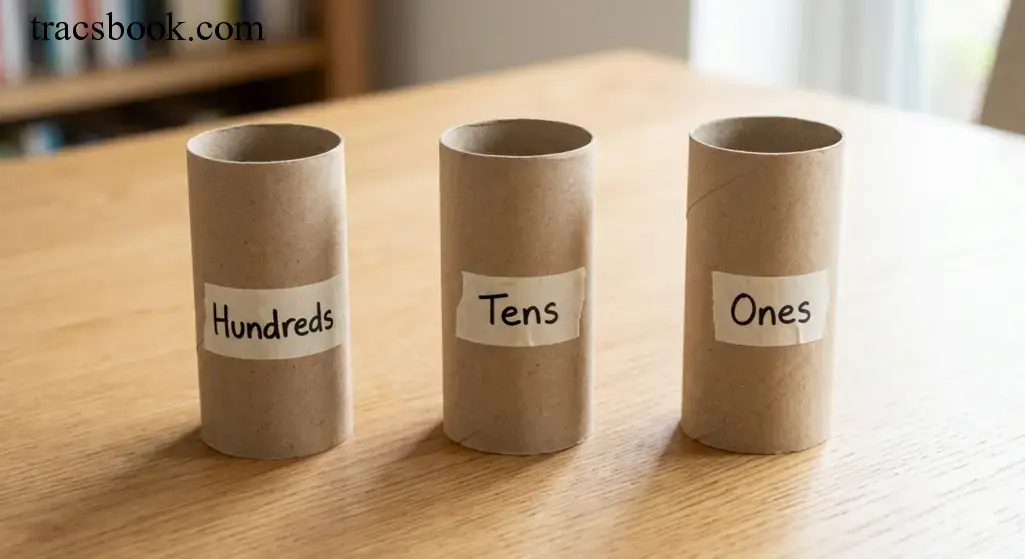
Welcome, young mathematicians! Today, we’re going on an exciting journey to explore how numbers are built. Imagine numbers like Lego creations – they’re made up of smaller, important pieces. We’re going to build a hands-on model to understand a concept called “Expanded Form.” This will help us see the true value of each part of a number.
Let’s start by gathering some everyday items that you can find around your home. We’ll need:
- Three empty toilet paper rolls or cut paper towel rolls. If you don’t have these, you can use three small, empty plastic cups, or even just three pieces of cardboard folded into small standing tents.
- A collection of small, identical objects – like beans, buttons, small pasta shapes, or even pebbles. Make sure you have at least 200 of them, but more is always better for practice!
- Three small pieces of paper and a pen or marker.
Step 1: Create Your Place Value Holders.
Take your three toilet paper rolls (or cups/cardboard tents). On one piece of paper, write “Ones” and tape it to the first roll. On the second, write “Tens” and tape it to the second roll. On the third, write “Hundreds” and tape it to the last roll. Arrange them in a row: Hundreds, Tens, Ones, from left to right. These are your special number-holding towers!
Do-It-Yourself-2: Concrete – Representing Numbers Physically
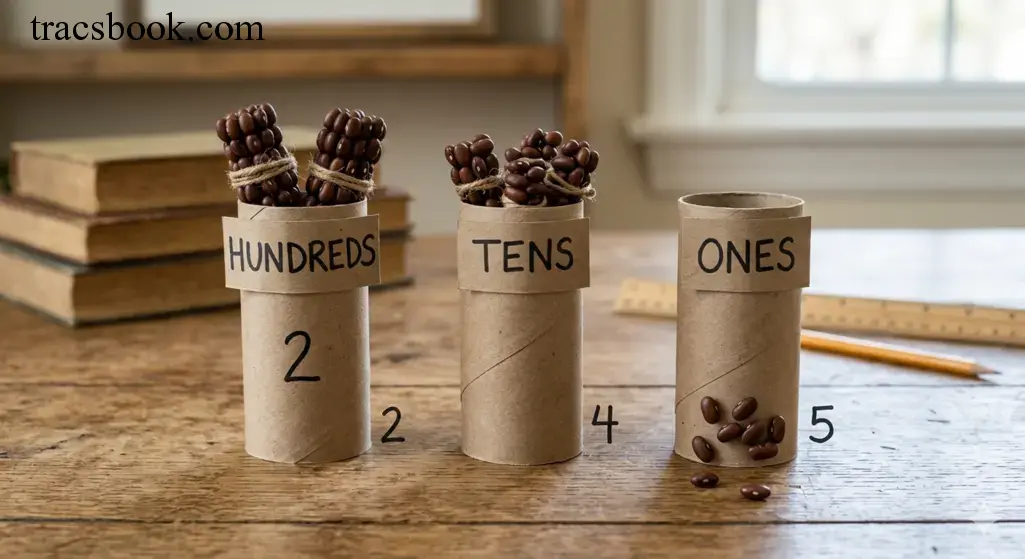
Now that you have your place value holders ready, let’s represent a number. We’ll use the number 245.
Step 2: Place Your Objects.
Remember that the “Ones” place tells us how many single items we have. The “Tens” place tells us how many groups of ten we have, and the “Hundreds” place tells us how many groups of one hundred we have.
- For the Ones Place (5): Take 5 of your small objects (beans, buttons, etc.) and carefully place them into the “Ones” roll.
- For the Tens Place (4): Now, for the “Tens” place, you need to think in groups of ten. Take 4 groups of ten objects. This means 10 + 10 + 10 + 10 = 40 objects in total. Place these 40 objects into the “Tens” roll. It’s important to remember that these 40 objects represent ‘4 tens’.
- For the Hundreds Place (2): Finally, for the “Hundreds” place, you need to think in groups of one hundred. Take 2 groups of one hundred objects. This means 100 + 100 = 200 objects in total. Place these 200 objects into the “Hundreds” roll. These 200 objects represent ‘2 hundreds’.
You should now see the number 245 physically represented in your model!
Build your own model! Take a moment to construct this setup. This hands-on process is key to understanding.
Do-It-Yourself-3: Concrete – Expanding Your Number
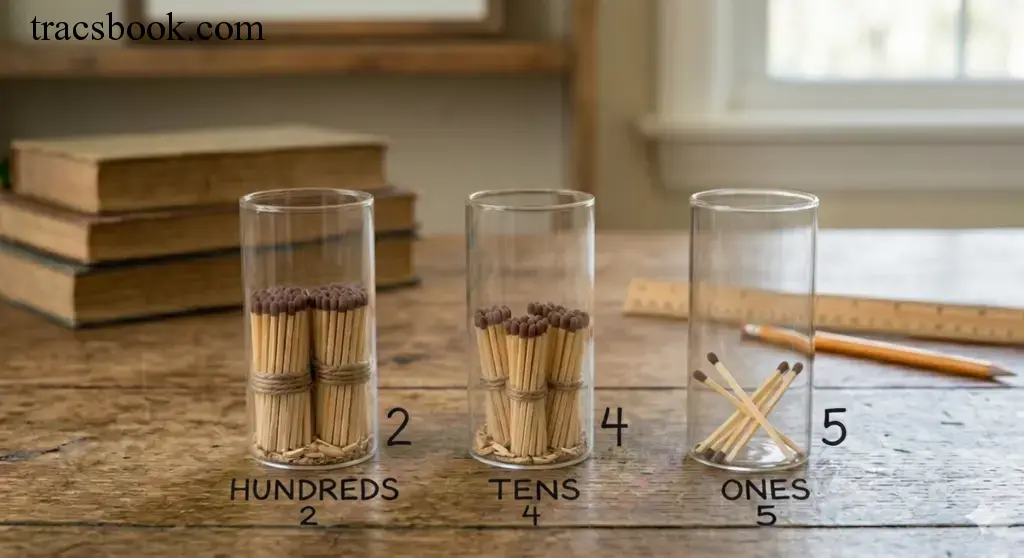
Now comes the exciting part: understanding the “expanded form”! This means we’re going to break apart our number 245 into the total value that each place holds.
Step 3: Deconstruct and Sum the Values.
Carefully empty the objects from each roll into separate piles on your table, making sure not to mix them.
- From the “Ones” roll: You have 5 objects. The value of 5 ones is simply 5.
- From the “Tens” roll: You have 4 groups of ten, which means you have 40 objects in total. The value of 4 tens is 40.
- From the “Hundreds” roll: You have 2 groups of one hundred, which means you have 200 objects in total. The value of 2 hundreds is 200.
Now, look at your three separate piles of objects. You have a pile of 200, a pile of 40, and a pile of 5.
When we put these values together, we get: 200 + 40 + 5.
This is the expanded form of the number 245! You’ve just physically shown how 245 is made up of 2 hundreds, 4 tens, and 5 ones.
Design-It-Yourself-1: Pictorial – Visualizing Place Value Blocks
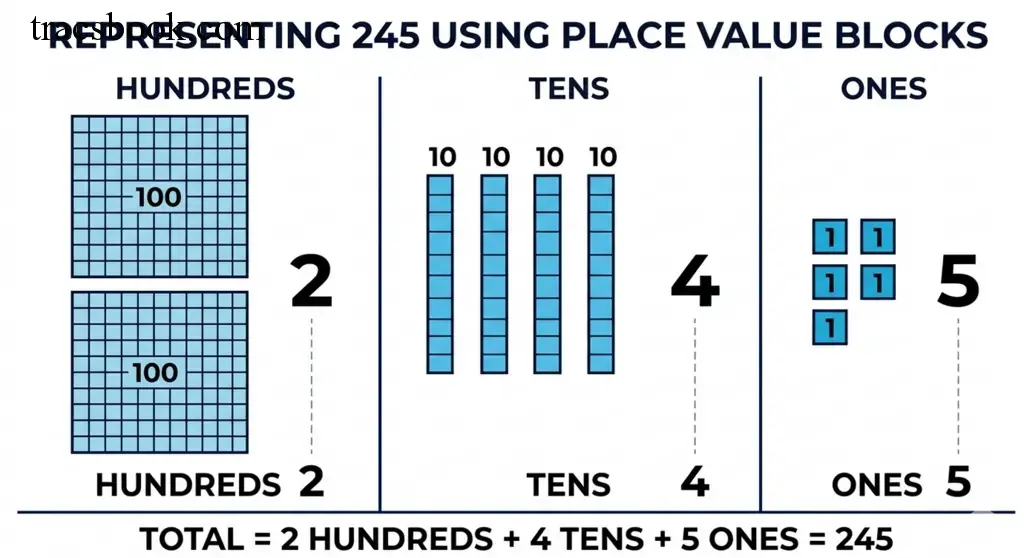
Fantastic work with your physical model! Now, let’s transition from those real-life objects to a visual representation using diagrams. This will help you see the same concept in a more standardized way, preparing you for abstract thinking. We often use special “place value blocks” to represent numbers visually.
Imagine these blocks:
- A small square block represents a “One.”
- A long rod made of 10 small squares represents a “Ten.”
- A large flat square, made of 100 small squares (10 rods), represents a “Hundred.”
Let’s draw the number 245 using these place value blocks:
- You will draw two large flat squares to represent 2 hundreds.
- You will draw four long rods to represent 4 tens.
- You will draw five small square blocks to represent 5 ones.
These blocks together visually represent the number 245, just like your beans in the rolls.