Do-It-Yourself-1: Concrete – Building with Your Hands!
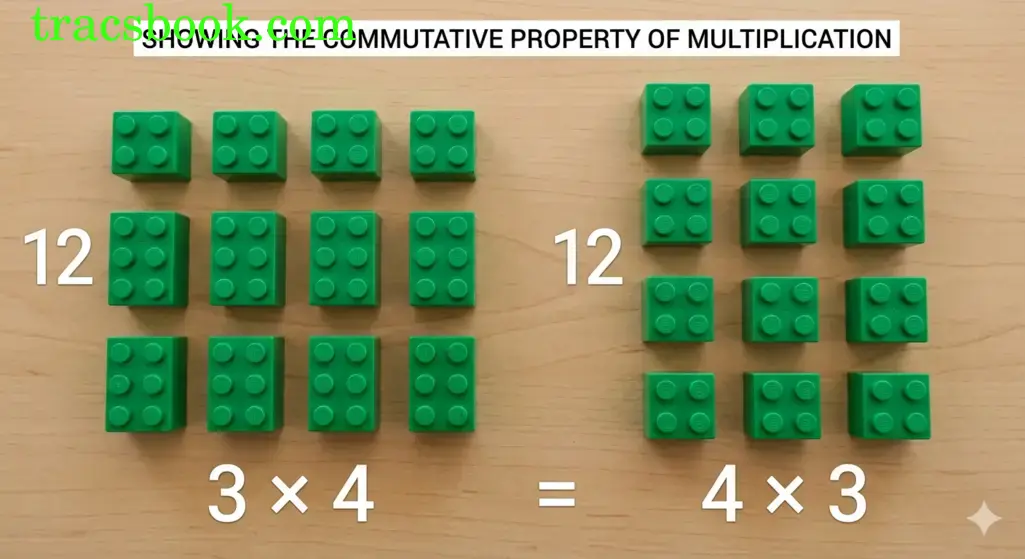
Welcome, young mathematicians! Today, we’re going to explore some amazing secrets of multiplication that will make your math journey even more exciting. Let’s start by getting our hands busy! We’re going to discover why sometimes, the order of numbers doesn’t change our answer.
Build your own model: The Commutative Property of Multiplication
- Gather your materials: Find 12 identical small objects. These could be small building blocks, buttons, beans, or even small pebbles. Make sure they are all the same size and shape.
- Make your first array: Arrange your objects into 3 equal rows with 4 objects in each row. Count them carefully. How many objects do you have in total? (You should have 3 groups of 4, which is 3 x 4).
- Rearrange for the second array: Now, take the exact same 12 objects. This time, arrange them into 4 equal rows with 3 objects in each row. Count them again. How many objects do you have in total now? (This is 4 groups of 3, or 4 x 3).
Look closely at both arrangements. What do you notice about the total number of objects in each setup?
Do-It-Yourself-2: Concrete – Building with Your Hands! (Part 2)
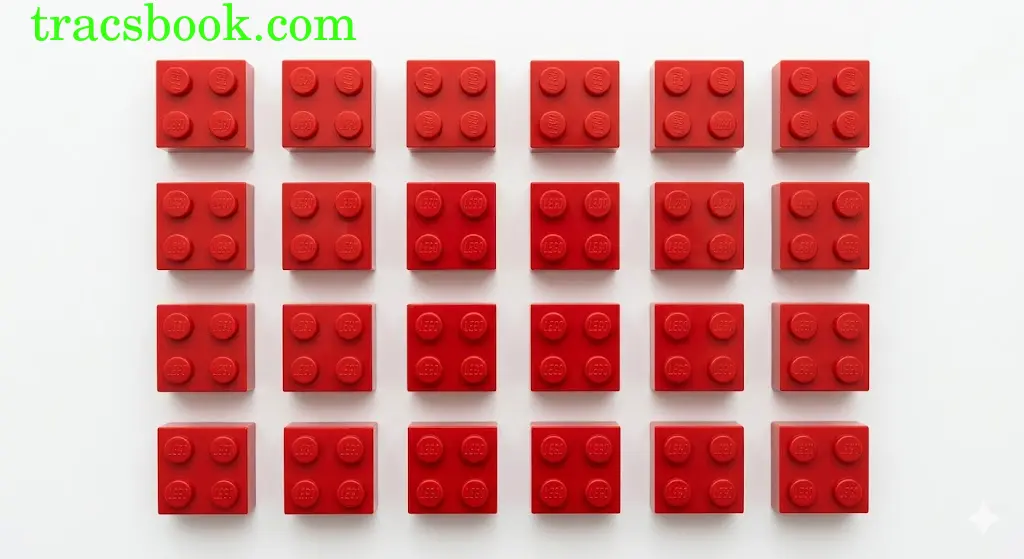
Fantastic work with the arrays! Now, let’s explore another cool property of multiplication, the Associative Property. This one helps us understand that when you multiply three or more numbers, the way you group them doesn’t change the final answer.
Build your own model: The Associative Property of Multiplication
- Gather different materials: For this, you will need three different types of small, identical objects or colors of blocks. For example:
- Type A: 2 green blocks
- Type B: 3 blue blocks
- Type C: 4 red blocks
(If you only have one type of block, you can use small paper labels or draw groups on paper to differentiate them.)
- Build Grouping 1: (A x B) x C
- First, make pairs using Type A and Type B: Build 2 sets, where each set has 3 blue blocks. So, you have two “towers” of 3 blue blocks. This is
2 x 3. - Now, imagine you need to make 4 copies of this whole structure (the two towers of 3). So, you would have 4 groups, and each group contains 2 sets of 3 blue blocks. Count the total number of blue blocks you’ve used. This represents
(2 x 3) x 4. (You might need to use more blue blocks or simply visualize replicating the2x3part 4 times, counting the3blocks in each set, then multiplying by2, then by4). - Simpler concrete for grade 3: Let’s use simpler block arrangement. Build 2 rows of 3 blocks each. Now, make 4 copies of this entire 2×3 rectangle using more blocks. Stack them or place them side-by-side. This represents
(2 x 3) x 4. Count all the blocks.
- First, make pairs using Type A and Type B: Build 2 sets, where each set has 3 blue blocks. So, you have two “towers” of 3 blue blocks. This is
Do-It-Yourself-3: Concrete – Building with Your Hands! (Part 3)
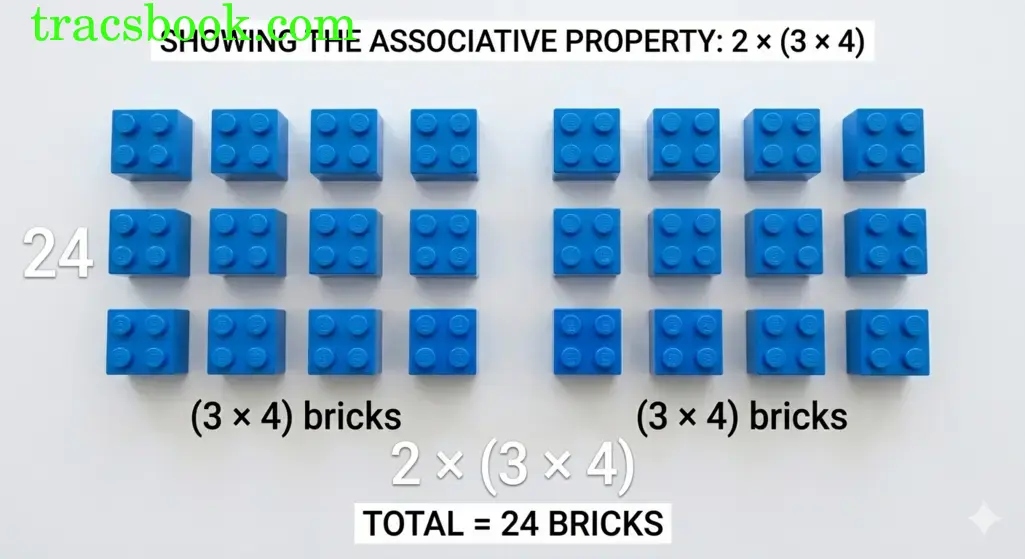
You’re doing great with your building! Now, let’s take the same numbers (2, 3, and 4) and try grouping them in a different way to see if our total changes.
Build your own model: The Associative Property of Multiplication (Continued)
- Build Grouping 2: A x (B x C)
- Instead of
(2 x 3) x 4, let’s try2 x (3 x 4). - First, focus on
(3 x 4): Build 3 rows of 4 blocks each. This forms a rectangle of 12 blocks. - Now, imagine you need to make 2 copies of this entire structure (the 3×4 rectangle). So, you would have 2 such rectangles side-by-side or stacked. Count all the blocks you’ve used for this second grouping. This represents
2 x (3 x 4).
- Instead of
Compare your two physical constructions from P2 and P3. In the first grouping, you made 4 copies of (2 rows of 3 blocks). In the second grouping, you made 2 copies of (3 rows of 4 blocks).
What do you notice about the total number of blocks in both models? Even though you built them differently, the final count should be the same! This is the magic of the Associative Property.
Design-It-Yourself-1: Pictorial – Seeing the Logic!
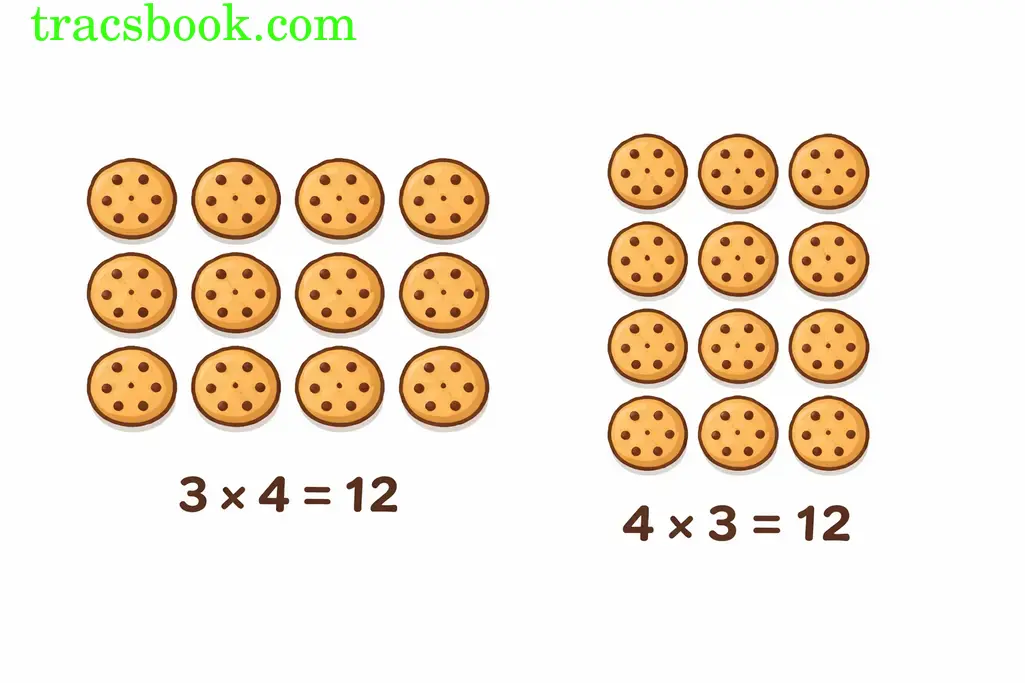
Now that you’ve built these concepts with your hands, let’s see how they look on paper. Visualizing math helps us understand it even better! We’ll start with the Commutative Property.
Visualizing the Commutative Property
- Imagine a tray of delicious cookies. If you have 3 rows with 4 cookies in each row, that’s
3 x 4. - Now, imagine turning the tray! It still has the same cookies, but now you see 4 rows with 3 cookies in each row. That’s
4 x 3.
Observational Notes:
- The total number of cookies remains 12 in both arrangements.
- We simply changed the way we looked at the cookies or arranged them.
- This property tells us that the order of the numbers we multiply (the factors) does not change the answer (the product).
- It’s like walking to school and then walking home. You walk the same distance, no matter which direction you go first!