Do-It-Yourself-1: Let’s Build Our Own Place Value Kingdom!
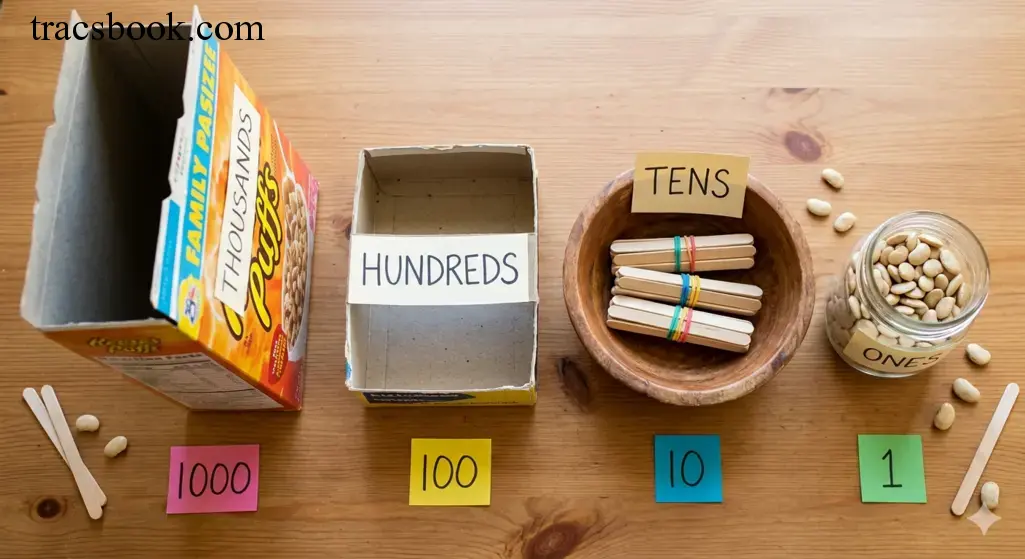
Hello, mathematicians! Today, we’re going on an exciting journey to understand how numbers work, especially big ones! We call this “Place Value.” Imagine you have a lot of items, like hundreds of small stones, or thousands of tiny beans. How do we count them without getting confused? We use place value! To make this super clear, we’re going to build a physical model that you can use over and over again. This will be your “Place Value Kingdom.”
Your Mission: Build your own model!
Materials you’ll need:
- Smallest items for “Ones”: About 50-100 pieces of dry beans, small buttons, or pasta shapes.
- Groups of ten for “Tens”: About 20 craft sticks, pencils, or even straws.
- Groups of a hundred for “Hundreds”: 5-10 small, empty matchboxes, small erasers, or small toy cars.
- Groups of a thousand for “Thousands”: 1-2 empty cereal boxes or larger shoeboxes.
- Labels: Small pieces of paper and a pen/marker.
Step 1: Gather your “Workers” and “Houses.”
Collect all your materials. Take your small items (beans/buttons) and set them aside. These are your “Ones.” Now, for your “Tens” items (craft sticks), group them into bundles of ten using a rubber band or tape. Do the same for your “Hundreds” items (matchboxes) if they are small enough to be grouped into tens of tens (100). For the “Thousands” (cereal boxes), they are already representing a large group.
Do-It-Yourself-2: Label Your Place Value Houses.
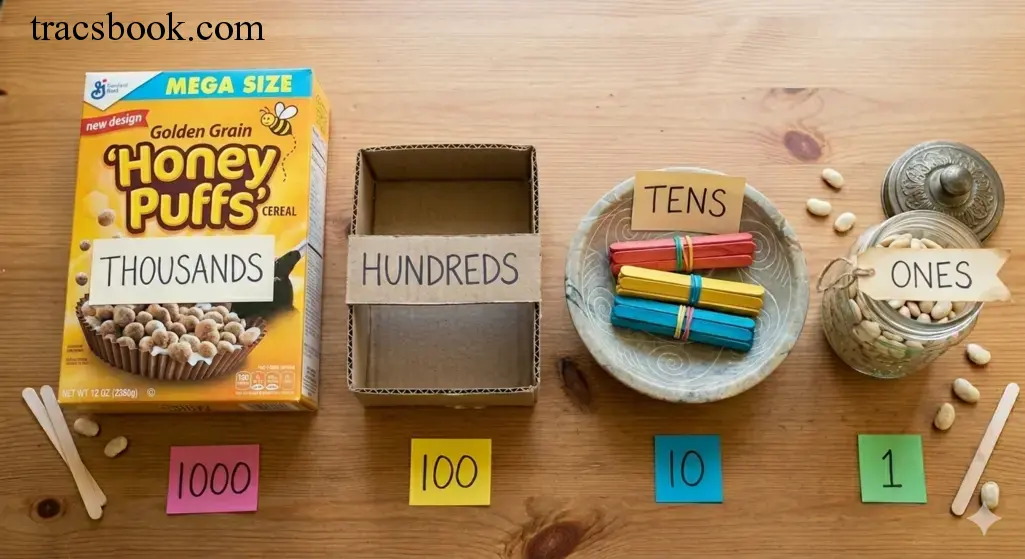
Now, let’s create your “Place Value Houses” or sections. You can draw lines on a large piece of paper, or just arrange your containers in a row. Take your labels and write “ONES” for the smallest items, “TENS” for the groups of ten sticks, “HUNDREDS” for the groups of hundred (matchboxes), and “THOUSANDS” for the largest group (cereal box). Arrange them from right to left: ONES, TENS, HUNDREDS, THOUSANDS. This order is super important in mathematics! Each house has a special job. The “Ones” house holds single items. The “Tens” house holds bundles of ten. The “Hundreds” house holds bundles of one hundred, and the “Thousands” house holds bundles of one thousand.
Do-It-Yourself-3: Representing Numbers with Your Kingdom.
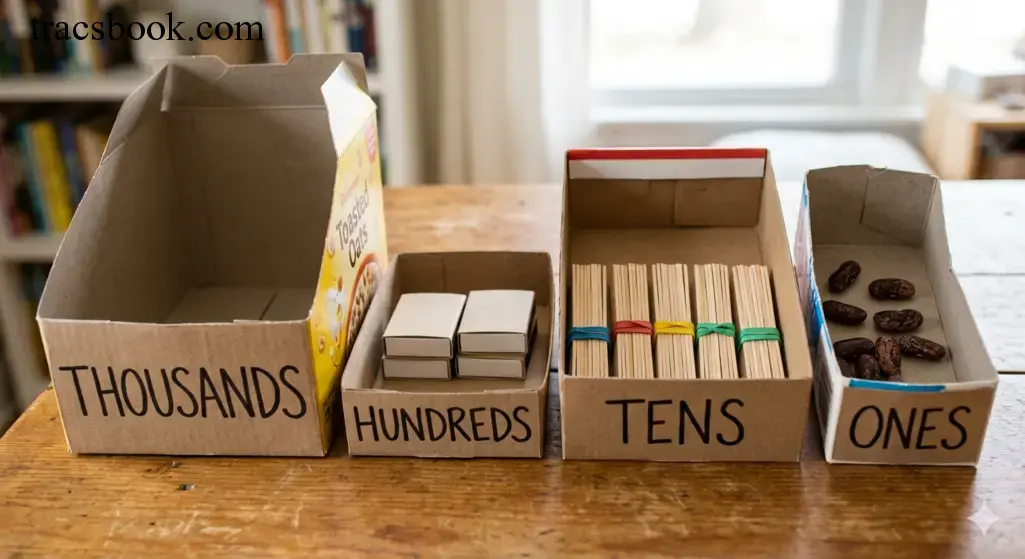
Let’s try representing a number! For example, let’s show the number 342.
- For the “ONES” place (rightmost): Count out 2 individual beans/buttons and place them in the “ONES” container. You have 2 ones.
- For the “TENS” place: Count out 4 bundles of ten craft sticks and place them in the “TENS” container. You have 4 tens, which is 40.
- For the “HUNDREDS” place: Count out 3 small matchboxes and place them in the “HUNDREDS” container. You have 3 hundreds, which is 300.
So, you have 3 hundreds, 4 tens, and 2 ones. This builds the number 342!
Now, let’s try a bigger number: 1,257.
- For the “ONES” place: Place 7 individual beans.
- For the “TENS” place: Place 5 bundles of ten craft sticks.
- For the “HUNDREDS” place: Place 2 small matchboxes.
- For the “THOUSANDS” place: Place 1 large cereal box.
See how your physical model helps you visualize the value of each digit? Each item’s “place” tells you its “value”!
Design-It-Yourself-1: Seeing Numbers Visually: Pictorial Representation.
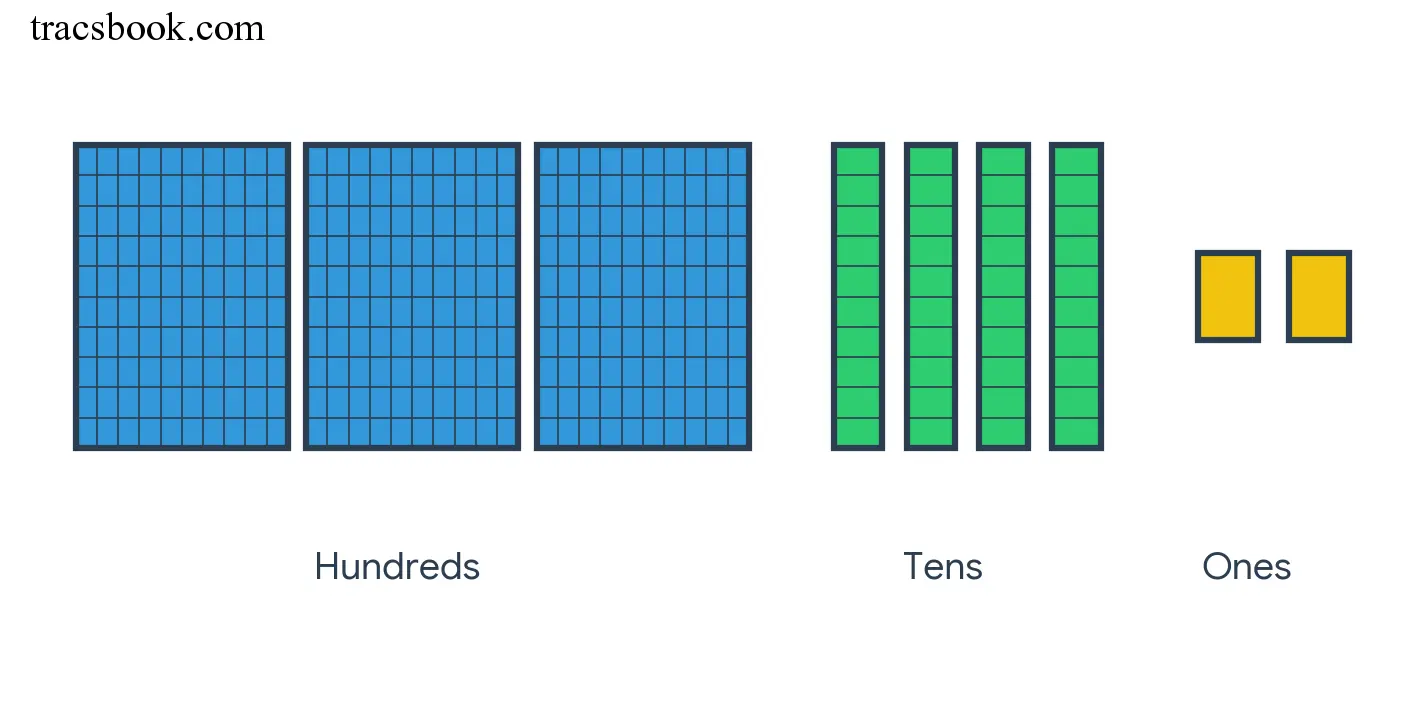
Now that you’ve built and used your physical model, let’s see how we can draw these ideas. Imagine your beans, sticks, and boxes are now simplified shapes on a flat page. This helps us think about numbers without needing all the physical objects.
Here’s how we represent different place values visually:
- Ones: We draw small squares or dots. Each dot represents 1 unit.
- Tens: We draw long rods or sticks. Each rod represents 10 units.
- Hundreds: We draw large squares or “flats.” Each flat represents 100 units (like 10 rods or 100 small squares).
- Thousands: We draw a large cube. Each cube represents 1000 units (like 10 flats or 100 rods or 1000 small squares).
Let’s represent the number 342 again, but this time, using these visual drawings:
- You would draw 2 small squares for the Ones place.
- You would draw 4 rods for the Tens place.
- You would draw 3 large squares for the Hundreds place.